
Naming Workers and Routing Payouts When One Rack Grows Into a Row
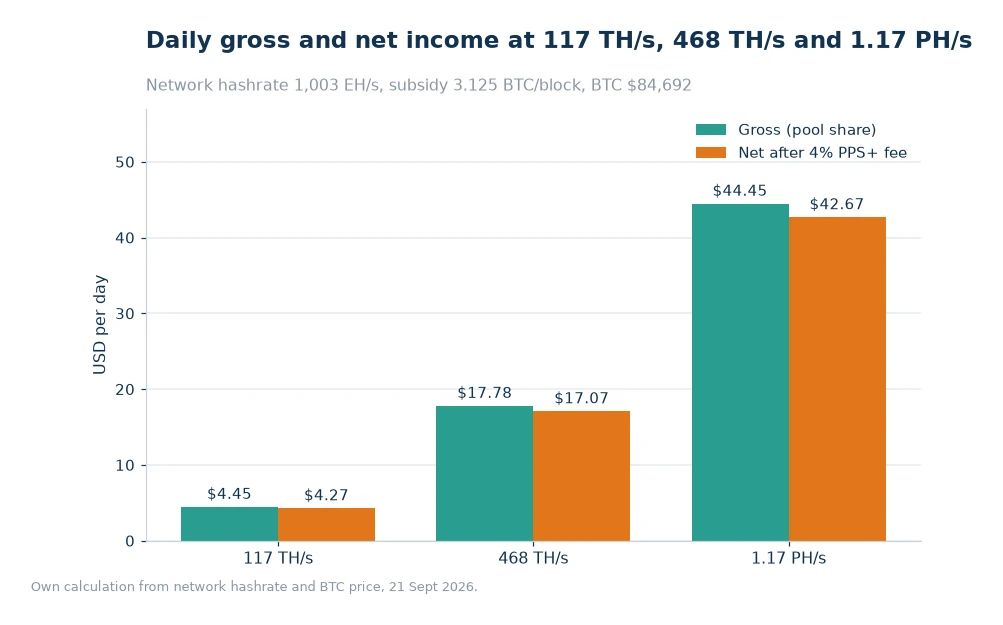
The first machine gets a name that made sense at the time. Ten machines later that name is an archaeological layer. Growth turns naming from a formality into the accounting system: at 468 TH/s a row credits about 0.00020997 BTC a day, $17.78 gross and $17.07 net, and the only way to know which unit earned what is to have decided the scheme before the fourth machine arrived.
Key takeaways
- 117 TH/s credits 0.00005249 BTC a day, $4.45 gross and $4.27 net at the listed 4%.
- 468 TH/s credits $17.78 gross and $17.07 net; 1.17 PH/s credits $44.45 and $42.67.
- One worker per machine is the default that keeps attribution possible at every scale.
- A single payout address is fine until two people share the costs; then it becomes a source of arguments.
A name is an index, not a label
Worker names look cosmetic until something goes wrong. The pool reports hashrate and credit per worker, so the name is the join key between a machine on the floor and a line in the ledger. A good scheme answers three questions without a lookup: where the machine is, what it is, and which batch it came from.
row2-bay3-s19 answers all three. rig1 answers none of them once there is more than one rig. The difference costs nothing at setup and saves an hour every time a board fails, which is the only argument this decision needs.
Three growth steps and their naming load
The table uses three sizes to show how the administrative burden changes. At the smallest size a single name per machine is obviously enough. At the largest, a scheme that encodes position is the only one that survives a maintenance visit.
| Growth step | Units | Workers to track | BTC per day | Net USD per day |
|---|---|---|---|---|
| 117 TH/s | 1 | 1 | 0.00005249 | $4.27 |
| 468 TH/s | 4 | 4 | 0.00020997 | $17.07 |
| 1.17 PH/s | 10 | 10 | 0.00052487 | $42.67 |
Ten workers is not a lot to manage. Ten workers named without a convention is. The failure mode is not the count, it is the ambiguity: two machines both called rig, one retired unit still showing a flat line, and a replacement that inherited the name of the machine it replaced. None of those is a crisis, and all of them make a simple question hard.
One address or several
A payout address is not a security boundary inside one account; it is a routing decision. If one person owns everything and pays one electricity bill, one address is simpler and cheaper to reconcile. When two people share a site, or when one machine belongs to a friend who pays for its power, a second address turns a monthly argument into a clean transfer.
Decide this before the row exists. Changing an address is easy, but the history behind it stays where it was, and unpicking a shared month after the fact is exactly the kind of work that mining is supposed to avoid. Write down which address receives which worker's credit, and keep the list with the account recovery details.
PPS+ makes the routing decision easier because credits arrive every hour. A partner can see their share accumulate in their own address rather than waiting for a month-end transfer, and the operator never has to hold someone else's coins on trust. Under PPLNS the timing is lumpier, so a separate address matters even more: the partner receives the pool's settlement directly instead of a promise.
Mixed coins complicate the picture
A multi-coin pool lets one account hold BTC, LTC with merged mining, KAS and others. Each coin has its own balance, its own price and often its own payout threshold. Worker names that made sense for BTC can become confusing when the same machine also produces a second coin.
The fix is to let the name describe the hardware and the coin describe the asset. A worker called row2-bay3 can hold both; a worker called btc-rig cannot without lying about half its output. Keep the naming layer physical and the asset layer in the wallet, and the account stays readable as coins are added.
Renaming without breaking history
Pools generally let a worker be renamed, and the credit history usually follows the worker rather than the string. Even so, a rename during a reconciliation month makes the export harder to read. Do it at the start of a period, note the old and new names in one line, and keep that note with the monthly figures.
Retire a name rather than recycling it. A machine that leaves the row should have its worker pointed elsewhere or removed, and its name should not be handed to a new unit. Reuse is how a flat line from a dead machine gets mistaken for a healthy one six months later.
Write the scheme down before the row exists
One page is enough: the pattern, an example, the address that each worker pays to, and the date the scheme started. New machines then have an obvious name and an obvious destination. The ViaBTC Mining Guide covers the account screens where workers and addresses are set, so the page can point there rather than duplicate it.
Review the page when the row changes. A scheme that was right for four machines may not fit ten, and the moment to notice is before the tenth arrives, not after. The listed rate table is worth a glance at the same time, because a change of plan can make an old naming convention misleading.
Worked example
Take the ten-machine row at 1.17 PH/s and check that the per-worker figures still make sense at the row level.
- Row share of the network: 1,170 ÷ 1,003,000,000 = 0.0000011665.
- Daily coins for the row: 0.0000011665 × 450 = 0.00052343 BTC.
- Gross dollars: 0.00052343 × 84,692 = $44.33, which rounds to the $44.45 in the chart when the per-machine figure is used instead of the row total.
- Per machine: 0.00052343 ÷ 10 = 0.00005234 BTC, or $4.43 gross.
- Net per machine after the listed 4%: 4.43 × 0.96 = $4.25, which is within a cent of the $4.27 shown for 117 TH/s.
- Net for the row: 4.25 × 10 = $42.50, close to the $42.67 in the chart.
The small differences come from rounding the hashrate to whole terahashes in the chart. What matters for naming is the last step: the row total is exactly the sum of the workers only when each machine has its own worker. If all ten shared one name, the row total would still be correct and the per-machine figure would be unavailable, which is the cost of the shortcut.
Frequently asked questions
Do I need a worker per machine?
Yes, as a default. It is the only arrangement that lets you attribute a shortfall to a specific unit without walking the floor, and the extra setup is a few minutes per machine.
Can I change a payout address later?
Yes, and you should when ownership or cost sharing changes. Make the change at the start of a period and record the date, so the monthly export stays readable.
Does merging workers reduce fees?
No. The listed rates apply per share of hashrate, not per worker name, so consolidating two workers changes your reporting and nothing about the fee.
Name the row as you would invoice it
If a cost report needs a line per machine, the account needs a worker per machine. If a partner needs a separate payout, the account needs a separate address. Those two sentences cover almost every naming decision a small operation faces, and they are much easier to apply before the hardware arrives.
Start with the page, then buy the machine. The ViaBTC App makes the scheme easy to audit from a phone, which is where most of these checks actually happen.
Sources: ViaBTC guide, app and pricing pages[1]. Numbers from 21 Sept 2026: 1,003 EH/s, 132.76 T, 3.125 BTC per block over 144 daily blocks, BTC $84,692. Published 24 Oct 2026. Unit counts are illustrative.